Seeing Through God’s Eyes: Desire, Diligence, Delight

Social media can be a strange place. Normally, I only post pictures of fish I’ve caught, a beautiful sunset, or my family. Those kinds of posts usually bring smiles and likes, nothing too controversial. But last week, I felt compelled to post something different.

I was moved by the ministry of Charlie Kirk, a young man who boldly entered college campuses to share his Christian faith. Whatever you think of his politics, I admired that he was willing to step into the arena—like Teddy Roosevelt’s famous description of “the man in the arena”—to engage those who disagreed with him. He was willing to be vulnerable and courageous in contending for the hope he had in Christ and his conservative beliefs and values. He invited people who disagreed with him, gave them a microphone and platform, and then respectfully engaged.

But when I shared a word of appreciation for that prophetic and evangelical witness, I quickly learned why I normally stick to fish pictures. Even in the wake of his tragic assassination, the politics surrounding his name created division. Friends unfriended and blocked me. People I thought knew me well assumed the worst because I raised a tribute to someone they apparently despised. It was a stark reminder of how polarized our culture has become, and how easy it is to cancel one another instead of listening and loving.

Splitting and the Culture of Cancellation

In recent Wall Street Journal commentary, “Splitting and the Celebration of Charlie Kirk’s Assassination,” the writer notes a psychological term used by psychotherapists for what they hear in their offices daily when “anger hardens into fantasy”: splitting.

Splitting is when we divide people into categories of “all good” or “all bad.” When someone offends us or disagrees with us, we label them evil and cut them out of our lives.

Social media supercharges this tendency. One post, one opinion, one moment — and suddenly someone is “dead” to us. We unfriend, block, or cancel. And while we may not see it this way, canceling someone is a kind of social murder. It removes them from our circle of care and erases them from our world.

Jesus warned about this very thing. In the Sermon on the Mount, He said:

“You have heard that it was said to those of old, ‘You shall not murder; and whoever murders will be liable to judgment.’ But I say to you that everyone who is angry with his brother will be liable to judgment; whoever says, ‘You fool!’ will be liable to the hell of fire.”
(Matthew 5:21–22)

To call someone a “fool” is to reduce them to a label, to strip them of dignity, to erase their humanity in your heart. That is the same destructive energy as splitting: we stop seeing the image of God in the other and see only a caricature.

We may not use the word “fool” much anymore, but we have a long list of replacements: fascist, Christian nationalist, Nazi, communist, racist, bigot, hater—on and on it goes. Once someone has been given one of these slur labels, they are no longer a complex human being made in God’s image. They are simply “the enemy.” And once they are “the enemy,” we feel justified in canceling them, cutting them off, or treating them with contempt.

Jesus Welcomes the Unwelcome

In Luke 15, Jesus gathers a crowd. Some were labeled “sinners,” others were tax collectors—the most despised people in society at the time. These tax collectors weren’t just IRS agents; they were Jewish men working for the occupying Roman Empire, extorting their neighbors to fill both Roman coffers and their own pockets. If there was ever a group that people felt justified in hating, it was them.

The Pharisees and scribes looked at this scene and grumbled: “This man receives sinners and eats with them.” They couldn’t comprehend why a holy man would welcome such company.

But here’s the irony: the only person in that gathering who wasn’t a sinner was Jesus. And He was the very one opening His arms, extending fellowship, and sharing meals with them.

Jesus refused to play by the rules of exclusion. He refused to label people as irredeemable. Instead, He told stories about a lost sheep and a lost coin to show that God’s heart beats for the one who is missing, the one who has wandered, the one everyone else has written off.

James Tissot (1836-1902). “The Good Shepherd,” (c.1886-1894. The Brooklyn Museum. Public Domain.

What We Can Learn

Those parables teach us three lessons—three “D’s” to guide our hearts and our mission.

Desire for the Lost

Do we share God’s desire to seek the lost? Every sheep matters. Every coin matters. Every person matters to God. That includes the people we’d rather avoid, the people we disagree with, even the people who hurt us.

Diligence in the Search

The shepherd leaves the ninety-nine to find the one. The woman lights a lamp and sweeps her whole house for the coin. There is intentionality and persistence in God’s search. What would it look like for us to be just as intentional—crossing barriers, stepping into uncomfortable conversations, or simply being present where people are?

Delight in the Found

When the lost are found, heaven rejoices. There’s a party for one sinner who repents. Think of that: the angels throw a celebration for every single return. How different would our communities look if we delighted in reconciliation rather than cancellation, if we threw parties for prodigals rather than writing them off?

A Better Way to See

The apostle Paul called himself the “foremost of sinners” (1 Timothy 1:15). He admitted his past as a blasphemer, persecutor, and violent man. Yet he said, “Christ Jesus came into the world to save sinners—of whom I am the worst.”

Paul wasn’t speaking from a place of elitist superiority but of humility. He saw himself as one beggar telling another where to find bread. That’s the posture the church is called to take—not arrogance, not condemnation, but grace-filled humility.

Too often, like the Pharisees, we divide the world into categories: good people and bad people, insiders and outsiders, “us” and “them.” We label whole groups as “the problem” and pat ourselves on the back for being better. But Jesus breaks down those categories. He shows us that every single person—even the ones we most want to avoid—has infinite worth in God’s eyes.

An Invitation

So what does this mean for us?

It means cultivating a heart that aches for the lost, like God’s does. It means practicing diligence in our own neighborhoods, schools, workplaces, and even online communities to reach out with love. And it means learning to rejoice when anyone takes a step toward Jesus—because heaven is already celebrating.

Instead of blocking, unfriending, or writing people off, what if we prayed for them? What if we looked for ways to connect rather than cancel? What if we remembered that no one is a lost cause in God’s eyes?

Thank God He never gave up on us. Let’s not give up on one another.

A Closing Prayer

Lord, give us Your heart for the lost. Help us to see through Your eyes, to desire those who wander, to diligently seek them out, and to delight in every soul that turns back to You. Keep us humble, remind us that we too are sinners saved by grace, and use us as instruments of reconciliation in a divided world. Amen.

Post is based on Sermon preached at St. Mark’s Episcopal Church, Jacksonville: The God Who Seeks The Lost (September 14, 2025).

Charlie Kirk: The Man in the Arena

Before anything else can be said, our hearts must turn to Charlie Kirk’s beloved wife and their young children. No words can carry the weight of their loss, nor can they ease the deep grief of a family suddenly bereft of a husband and father. As a community, we are called to weep with those who weep (Romans 12:15), to uphold them in prayer, and to surround them with tangible love and care. Their sorrow is heavy, but they do not walk alone. May the Lord, who is “a father to the fatherless and a defender of widows” (Psalm 68:5), be their refuge and strength in these dark days. I pray that his children, though deprived of his presence, may one day see clearly that their father’s courage and faith were godly and true. Yet we acknowledge with broken hearts that it would have been far better for them to have their father by their side.

Deacon Stephen, the first to be killed for his belief in Jesus, asked, “Which of the prophets did your fathers not persecute?” (Acts 7:52).

In every respect, Charlie Kirk was a godly prophet—courageous in ways that many seasoned leaders in the church often fail to be. One reason why so many young adults were drawn to him and his open forums was that he was willing to discuss any subject, debate any topic, and wrestle with what God’s Word and his Christian faith had to say about it. Nothing was ever off the table. Most of us would never submit our deeply held convictions about faith and politics to the public, content to speak only in safe spaces and behind cloistered walls. But not Charlie Kirk—he was brave enough to take the truth of God into the arena.

I have noticed that some are cynically commenting on the irony of his defense of the Second Amendment. Of course, gun control is a hot topic in our public debate. But so too should be the heart, mind, and ideologies behind those who would assassinate defenders of rights and freedom. The defense of our freedoms carries inherent risk. Charlie Kirk was brave, truth-speaking, public. He submitted himself and his ideas to debate and scrutiny. He was open and vulnerable—vulnerable to being proven wrong, vulnerable to having his ideas tested, vulnerable to public ridicule and scorn, vulnerable to being canceled, vulnerable even to being killed.

By contrast, the assassin is a coward. He hides in the shadows, under cover of darkness. He is faithless, a hater of truth and light—evil. God sees and knows, and the assassin has done evil in the sight of the Lord (Proverbs 15:3).

“Which of the prophets did your fathers not persecute?” (Acts 7:52). The words of Jesus also ring true: “O Jerusalem, Jerusalem, the city that kills the prophets and stones those who are sent to it!” (Matthew 23:37). Unfortunately, these words have been fulfilled again.

Charlie Kirk stood up for family, for moral clarity, for the freedom of inalienable rights, and for divine truth. And for that, he was murdered in the public square. I cannot help but think about the call of Jesus before he ascended: “But you will receive power when the Holy Spirit has come upon you, and you will be my witnesses in Jerusalem and in all Judea and Samaria, and to the end of the earth” (Acts 1:8).

Charlie Kirk was courageously faithful to this mission. He was a witness for Jesus Christ, relying on the empowerment of the Holy Spirit to give him the words. In the early church, the Greek word behind our English “witness” became synonymous with giving up one’s life for the faith. That word is martyr. Charlie Kirk is a witness—and a martyr—for Jesus Christ.

There are seasons when culture becomes corrupt through godless thinking. Ours is such a season, and we need more Charlie Kirks to stand up and speak. Of course, he has shown us the cost of such a stand. Each of us must summon our own courage and be responsible for our own witness. At times, Jesus spoke boldly, and at times, he remained silent (cf. John 18:33–37; Mark 14:61). We are called to be “wise as serpents and innocent as doves” (Matthew 10:16ff.). Persecution will come. The days are evil (Ephesians 5:16). We are also called to be the salt of the earth and the light of the world (Matthew 5:13–16). Charlie Kirk rightly critiqued the church for too often hiding its light under a bushel and losing its saltiness.

It has often been said in moments like this: “The blood of the martyrs is the seed of the church.” Church history is replete with those who bravely faced the sword, imprisonment, stoning, wild beasts, fire, and the cross—all to bear witness in Jesus’ name. These are those “of whom the world is not worthy” (cf. Hebrews 11:35–38). Their martyrdoms never go unnoticed. They become beacons of greater faith and courage by those who share their beliefs. Not only does the Lord see their testimony, but so does a watching world. This is the paradoxical power of the cross and the crucified life. To the world it is foolishness, but to us who are being saved, it is the power of God (1 Corinthians 1:18).

Charlie Kirk’s ministry was called Turning Point. The name itself is inspirational, envisioning young adults recognizing their calling to be the change in this world. We are indeed in a time where we need a turning point—for our culture, our country, and our world—to turn back to God and to faithfulness to His Word. This too is a prophetic call. Just as 9/11/2001 became a turning point when many turned to the Lord in the face of horrific evil, may September 10, 2025, be the prescient moment of a turning point for renewed witness for Jesus Christ in the public arena.

Here Roosevelt’s words seem prophetic: “It is not the critic who counts; not the man who points out how the strong man stumbles… The credit belongs to the man who is actually in the arena, whose face is marred by dust and sweat and blood… who errs, who comes short again and again… but who does actually strive to do the deeds… who knows great enthusiasms, the great devotions; who spends himself in a worthy cause; who at the best knows in the end the triumph of high achievement, and who at the worst, if he fails, at least fails while daring greatly.” Charlie Kirk dared greatly, because he was the man who was actually in the arena.

Evil may think it has won a victory in silencing a compelling voice and extinguishing a bright light for God. But this is Satan’s downfall. The cross of Jesus Christ is the true victory. Those who pick up their cross and follow Him will overcome, tearing down the gates of hell “by the blood of the Lamb and by the word of their testimony, for they loved not their lives even unto death” (Revelation 12:11).

“Go and Do Likewise”: A Gospel Reflection on the Good Samaritan (Luke 10:25–37)

Heavenly Father, thank you for the gift of your word and for your gospel. May we not just be hearers of your word, but doers also. As Jesus said, “Go and do likewise.” Amen.

Who Is My Neighbor?

To understand the impact of this parable, we must first understand the context. It all starts with a conversation between Jesus and a lawyer. And not just any lawyer—a theologian, an expert in the law of God. We might say he was like a priest and a judge all rolled into one. As someone who interpreted the law for the people of Israel, he would have known the Scriptures inside and out.

When Jesus told the parable of the Good Samaritan, he never actually used the word good to describe the Samaritan. That was our addition. In fact, the central figure of the story—the Samaritan—is simply identified by his ethnicity, which was a scandal to Jesus’ original audience.

And yet, Luke tells us plainly: the lawyer stood up to test Jesus.

Testing the Teacher

This wasn’t an innocent question. It was a trap. Like a journalist trying to bait a politician with a “gotcha” question, the lawyer asked, “What must I do to inherit eternal life?”

Jesus, as he often did, answered the question with another question: “What is written in the law? How do you read it?”

The lawyer replied with what every Jewish child was taught: “You shall love the Lord your God with all your heart, soul, strength, and mind, and love your neighbor as yourself.”

“You have answered correctly,” Jesus told him. “Do this, and you will live.”

But the lawyer wasn’t satisfied. Luke tells us he wanted to justify himself. And so he asked, “And who is my neighbor?”

This question reveals a deeper spiritual problem—not just confusion, but resistance. The lawyer wanted to draw the circle of “neighbor” in such a way that it fit his lifestyle and limited his obligations. In short, he wanted to shrink God’s command down to a manageable size.

Self-Justification vs. True Righteousness

Here lies the fundamental error: we often try to adjust God’s Word to fit our lives, rather than conforming our lives to God’s Word. The lawyer was doing what many of us do. He was attempting to justify himself by narrowing the scope of love.

But Jesus, as always, refuses to play along.

Instead of answering with a direct definition, Jesus tells a story—a parable designed not just to teach, but to trap the hearer in a mirror of their own heart. It’s not unlike what the prophet Nathan did to King David. Sometimes the most effective way to reach a hard heart is through a story that invites the hearer to unknowingly step into their own judgment.

The Man in the Ditch

So Jesus tells of a man traveling the dangerous road from Jerusalem to Jericho—a notoriously treacherous path. The man is attacked, robbed, and left half dead.

Two religious figures pass by: first a priest, then a Levite. Neither stops to help. Perhaps they feared ritual impurity. Perhaps they were busy. Perhaps they were just indifferent. Whatever the reason, they chose distance over compassion.

Then, a Samaritan—a hated outsider—comes by. He sees the man. He has compassion. He bandages the wounds, transports him on his own animal, pays for his care, and promises to return.

The Good Samaritan

Jesus then turns the question back to the lawyer: “Which of these three, do you think, was a neighbor to the man who fell into the hands of robbers?”

The lawyer can’t even say “the Samaritan.” He answers: “The one who showed him mercy.”

Jesus replies: “Go and do likewise.”

Becoming the One in Need

What Jesus masterfully does in this parable is shift the lawyer’s point of view. The question was “Who is my neighbor?”—implying that I am the helper, and they are the potential recipients.

But Jesus flips it. You’re not the priest. You’re not the Levite. You’re not even the Samaritan. You’re the man in the ditch.

This is the moment of grace. Jesus invites the lawyer—and us—to stop seeing ourselves as the righteous ones doling out mercy, and instead as the broken ones in desperate need of it.

That kind of recognition changes everything. If you’ve ever been the one in need, you know that when you’re lying in the gutter, bleeding out, you don’t care if your rescuer is rich or poor, black or white, Republican or Democrat. You just want help.

As Ronald Reagan once said to his doctor after being shot: “I hope you’re all Republicans.” The doctor wisely replied, “Mr. President, today we’re all Republicans.” When mercy is needed, identity politics melt away.

Not Mostly Dead—Totally Dead

There’s an old joke from The Princess Bride—a man is “mostly dead,” which is still “slightly alive.” But Scripture says we’re not mostly dead in our sins—we’re completely dead. Hopeless. Helpless. Unable to revive ourselves.

That’s why this story isn’t just about being merciful like the Samaritan. That’s certainly part of it. But it’s also a portrait of salvation.

Jesus doesn’t just bind our wounds and leave us at an inn. He goes all the way to the cross. He lays down his life for us. He takes our place, pays our debt, and offers us a new one—his life.

Transformed by Mercy

So where are you in the story?

  • Are you trying to justify yourself? Adjusting God’s commands to fit your lifestyle?
  • Or are you ready to admit that you’re the one in the ditch—dead in sin and in need of a Savior?

Here’s the truth: Jesus doesn’t come to affirm your lifestyle. He comes to transform your heart.

The simple prayer is this:

“Lord, thank you for saving me. Forgive me for my sin. Fill me with your Holy Spirit. Conform my life to your will. Transform me into the person you’re calling me to be.”

That’s the heart of the gospel. We don’t justify ourselves. We are justified by Jesus.

And in response to that mercy, Jesus says:

“Go and do likewise.”

Want to reflect more?

Pray through Luke 10:25–37 and ask:

  • Who do I relate to most in this story?
  • Am I trying to define who deserves my love—or am I letting Christ define what love looks like?
  • Where is God calling me to offer mercy, even if it’s inconvenient?

Let the Word not just be something you hear, but something you do.

From Babel to Pentecost: Turning Outward Toward God

What a joy it is to witness the movement of the Holy Spirit in real time—not just in Scripture, but in the lives of God’s people today. On Pentecost Sunday, as we celebrated seven baptisms in our congregation, we experienced firsthand the promise that still echoes from the prophet Joel and the apostle Peter:

“Everyone who calls on the name of the Lord shall be saved.”

Let’s take a moment to reflect on the divine reversal that Pentecost offers—from Babel to Jerusalem, from confusion to communion, from human striving to Spirit-filled unity.

The Tower of Babel: A Name for Ourselves

In Genesis 11, we see humanity united in purpose—but not in worship. They say, “Come, let us build ourselves a city… and make a name for ourselves.” It’s an image that looks eerily like modern-day efforts: global unity without God, progress without repentance, technology without humility. It’s the city of man, as Augustine would say—built on pride, curved inward on itself (incurvatus in se).

The result? God scatters them and confuses their language. Not out of wrath, but mercy. To slow our descent into self-idolatry. To turn our hearts outward once again.

The Day of Pentecost: A Name Above Every Name

Then in Acts 2, we see a beautiful reversal. Where Babel brought confusion, Pentecost brings clarity. Where pride divided, the Spirit unites. Ordinary Galileans proclaim the mighty works of God, and every nation under heaven hears the good news in their own tongue.

It’s not about building a name for ourselves anymore—it’s about lifting high the name of Jesus. That’s the heartbeat of Pentecost: God making a name for Himself through His Spirit-filled people.

And Peter’s call still rings out:

Repent. Be baptized. Receive the gift of the Holy Spirit.

https://images.squarespace-cdn.com/content/v1/5b0166d2f2e6b1d4bfbc5dab/efc49ab1-d1be-4749-a505-53a02e0bee03/ARW47608-Pano.jpg

Baptism: Turning Outward in Faith

As we baptized children and welcomed them into the family of God, we weren’t just performing a ritual. We were bearing witness to a spiritual reality: the old self is buried, and a new life is born. These families stood before the congregation, renouncing the self-centered kingdom of man and embracing the kingdom of God.

It’s not just their promise. It’s ours too. The promise of forgiveness, of new life, and of the indwelling Spirit is for you—for your children, and for all who are far off.

The Call of Pentecost Today

What does it mean to live in the power of Pentecost?

It means asking daily, “Lord, fill me with Your Spirit.”
It means refusing to build monuments to self, and instead building altars of praise.
It means turning outward—toward God, toward others, and toward the mission of Jesus.

Friends, this is not a story from long ago. It’s our story now. The Spirit who fell at Pentecost is still being poured out on all flesh—on the young and old, the broken and the bold, the ordinary and overlooked.

So today, will you turn outward? Will you call on the name of the Lord?

If so, here’s a simple prayer:

Lord Jesus, I renounce pride and self-reliance. I turn to You. Fill me with Your Holy Spirit, that I may be Your witness and walk in Your ways. Amen.

And may the Spirit who hovered over creation, who fell like fire at Pentecost, now renew you, your family, and this whole world in the love of Christ.

The Author Steps Onto the Stage

There’s a moment at the end of a great play when the author walks onstage. The curtain’s drawn, the story complete, and now the playwright himself steps into the light, reminding us that everything we’ve just witnessed came from his mind, his hands. As C.S. Lewis once reflected, that’s how you know the play is over—the author appears.

And in the final pages of Revelation, we find just that: the Author of history stepping onto the stage.

“Behold, I am coming soon, bringing my recompense with me… I am the Alpha and the Omega, the first and the last, the beginning and the end.” (Revelation 22:12–13)

Jesus—our risen Lord—doesn’t just pen the introduction or write the final chapter. He is the story. Every word, every letter. Alpha to Omega. The first and the last. He is the Author, and He has a word for us.

The Reality of the Story We’re In

We live in a time that’s lost its story. Modern philosophy—rooted in Descartes’ “I think, therefore I am”—has shifted our focus inward. And that’s led to what we now call deconstructionism: the belief that there is no grand story, no meta-narrative, no Alpha and Omega. Everyone has “their truth,” but few are asking what’s true.

The result? Confusion. Division. Tribalism. One story pitted against another, each competing for dominance. But Revelation reminds us that there is a story—one written from the foundation of the world. And it’s not ours to edit.

Jesus says, “I am coming soon.” Whether we embrace the story or try to rewrite it, the Author will return—and He will hold us accountable. Not to punish, but to set things right. To bring clarity. To heal what’s broken.

Two Responses

On that day, there will be two responses to the Author’s appearing.

One is found in those who have “washed their robes”—a symbol of redemption, of sinners made clean through the blood of Christ. These are the ones who will eat from the tree of life and enter the city by its gates.

But there’s another group. It’s a sobering image: “Outside are the dogs, the sorcerers, the sexually immoral, the murderers, the idolaters, and everyone who loves and practices falsehood.” (Revelation 22:15)

This verse often gets left out. It’s uncomfortable. It’s not “nice.” But it’s honest—and necessary. Because the love of God tells the truth. And that truth is this: either you let Jesus wash your sins, or you choose to carry them yourself.

Lady Macbeth once cried out, “Out, damn’d spot!” as she imagined blood on her hands from her guilt. But no matter how much she scrubbed, the stain remained. Shakespeare, like the prophets, understood something deeply human: we all want to be clean, but we cannot cleanse ourselves.

Only Jesus can.

https://images.fineartamerica.com/images/artworkimages/mediumlarge/3/christ-enthroned-in-majesty-darcy-garneau.jpg

Don’t Change the Story

The final warning of Scripture is a plea: don’t add to these words, and don’t take away from them. Yet how often do we do just that? We add extra writings. Or we delete the difficult parts. We want a god who sounds more like us—more tolerant, more relaxed, less demanding.

But that isn’t the Author. That’s a counterfeit.

The real Author offers not just judgment but grace. “Let the one who is thirsty come; let the one who desires take the water of life without price.” (Revelation 22:17) This invitation—wide open and full of mercy—is spoken by both the Spirit and the Bride (the Church). It’s not exclusive. It’s not narrow. It’s generous. And it’s for you.

No matter your story, Jesus wants to redeem it. He wants to write you into His story—one of cleansing, restoration, and purpose.

One Prayer, One People

In His final prayer before the cross, Jesus prayed for us:

“That they may all be one… I in them and you in me, that they may become completely one, so that the world may know that you have sent me and have loved them even as you have loved me.” (John 17:20–23)

Our unity as believers isn’t based on preference or personality. It’s grounded in truth. When we cling to the Author’s story, we become living witnesses to the world—a people marked not by confusion, but by conviction and grace.

The final words of the Bible are not threats. They’re promises.

“Surely I am coming soon.”
“Amen. Come, Lord Jesus.”
“The grace of the Lord Jesus be with all. Amen.”

That’s the heart of the gospel. A warning and a welcome. A righteous Judge and a loving Savior. A story that invites us in, just as we are—and transforms us.

Blessed are those who wash their robes in the blood of the Lamb.

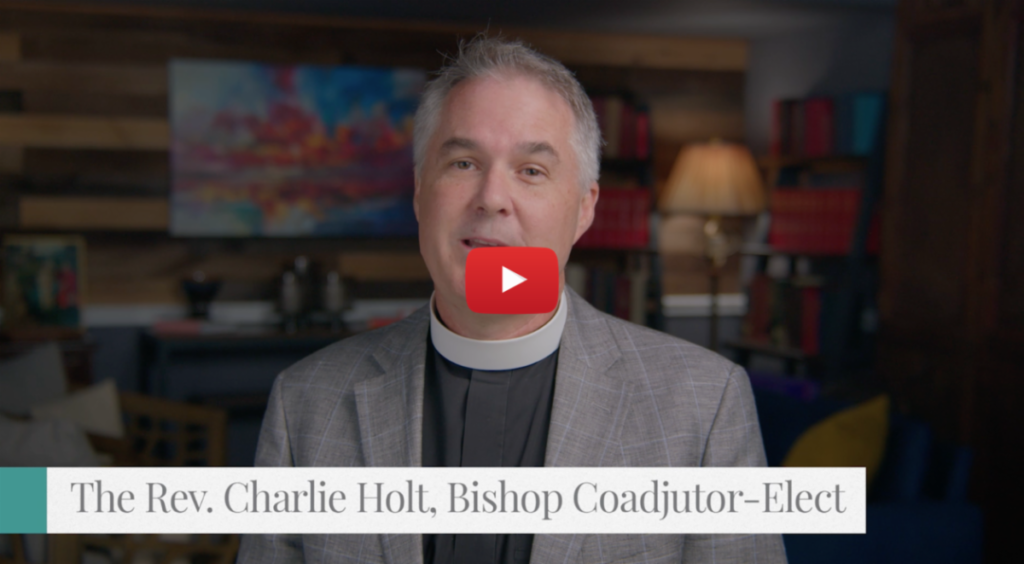
A Message from The Reverend Charlie Holt

Dear Members of the Diocese of Florida and the Episcopal Church,

Since my initial letter to you in May, I have continued to listen and have conversations with individuals across our Diocese and Church to build important relationships, openly discuss and alleviate concerns and begin our relationship free of misunderstanding.

In an effort to continue down that path, I wanted to take time to respond to the concerns recently raised by the LGBTQ+ Caucus to the 80th General Convention as well as share more context with you and our broader community. I have done so in the video below. Additionally, several faith leaders and ministry partners from Sanford, Florida have shared testimony of our relationship and times together, which you may view below the video. I hope both of these materials provide you with more clarity and context about my position on these important topics. If you have further questions, please contact me any time at cholt@diocesefl.org and I’ll be happy to arrange a conversation.

I am faithfully yours in Christ Jesus our Lord,

The Reverend Charlie Holt Bishop Coadjutor Elect, Diocese of Florida

Washing the Inside Out

Sermon on clean and unclean from Mark 7

It is easy to mistake having your religious act together for spiritual maturity. The heart of true religion is a matter of the heart. The Lord came to make the unclean clean from the inside out. May his heart be ours.


Sermon preached at St. John the Divine on 28 August 2021. Visit: https://www.sjd.org/

Keeping Freedom

As we approach Independence Day in the United States, I like to think about the Declaration of Independence and the inalienable rights that it acknowledges God has endowed for all people. The founding fathers of the United States placed their emphasis on freedom. Even continuing to today, it’s still somewhat of an experiment: Just how free can a people be? The concern is, of course, that when people have too much freedom, it results in anarchy. Just look at a room full of uncontrolled children to see how freedom can go wrong!

Our Scripture passage from Galatians also speaks to this tension. The body of Christ at Galatia had Gentiles coming into the fellowship, which is good, but they were bringing their unregulated lifestyles with them, which was introducing chaos into the body. In a case like this, humanity’s first instinct is to start making rules, setting laws, trying to bring the unruly members under control. But Paul says, this isn’t necessarily the answer. He challenges the Galatian church that it’s not about rules and laws, but rather about freedom.

For freedom Christ has set us free; stand firm therefore, and do not submit again to a yoke of slavery.

Galatians 5:1

There’s a one-two punch to the Gospel, the coming of Jesus Christ. The first punch is the Cross of Jesus Christ, which deals with sin and judgment and wipes our slates clean. Through this, we are set free from the fear of judgment and condemnation (Romans 8:1). And this is wonderful, but it can’t stop there. We don’t just leave it at freedom. “Woohoo! Eat, drink, and be merry! Life, liberty, and the pursuit of happiness!” No, unmitigated freedom results in licentiousness, which is a problem. We may try to combat the licentiousness with law, but that is trying to introduce an external force to solve an internal problem. The problem of licentiousness is in the heart, and that can’t be solved through regulation or governance. It never has worked, and it never will.

This is where the second punch comes in. God deals with the internal problems of the heart through the infusing of the heart of every Christian with his own Holy Spirit. The fundamental solution to all of the problems in our society and world is not a legal or political one, but rather an internal transformation that comes by the Gospel of Jesus Christ and the working of the Holy Spirit inside each believer. This is how a people and a nation can be transformed and live in a state of harmony.

But I say, walk by the Spirit, and you will not gratify the desires of the flesh. For the desires of the flesh are against the Spirit, and the desires of the Spirit are against the flesh, for these are opposed to each other, to keep you from doing the things you want to do. But if you are led by the Spirit, you are not under the law.

Galatians 5:16-18

The law and the flesh feed off of each other. If you really want to go to war against the flesh, you don’t do it with law, you do it with Spirit.

Those who belong to Christ Jesus have crucified the flesh with its passions and desires.

Galatians 5:24

This is the urgency of the mission of the Church in our day. We don’t need more political solutions. We need the Gospel to spread throughout our nation and world. We need the Spirit of God directing people to live together in righteousness and peace.

Each of us are individually called to apply to our own lives the one-two punch of the Gospel — to live in the freedom that comes from being forgiven, and to walk in the Spirit of God and bear his holy fruit. If we can get that into our own hearts and the hearts of our children, the strong hands of rules, laws, and government become unnecessary. Instead, we will have a taste of heaven on earth. This is what the Lord is offering his Church, both now and forever. Accept it today.

Draw Near: Hebrews on Christian Worship

Now Available!

Let’s face it, the Christian life is hard. Relationships take work. Christians forget. Sometimes it is tempting to go back to the days when God was not the center of our lives—to backslide. We all are faced with tremendous pressures to drift away from intimacy with Jesus and the community of
the church. However, the Lord invites us to pay attention, to move forward, to draw near, and to live lives of worship.

Click the image above to watch the video.